

Microsoft Teams calling, done locally
Make and receive phone calls in Teams on desktop, mobile and web. FirstNet delivers Operator Connect and Direct Routing over its ICASA-licensed network, with local numbers, porting and support.
Watch: Business voice is more than a phone
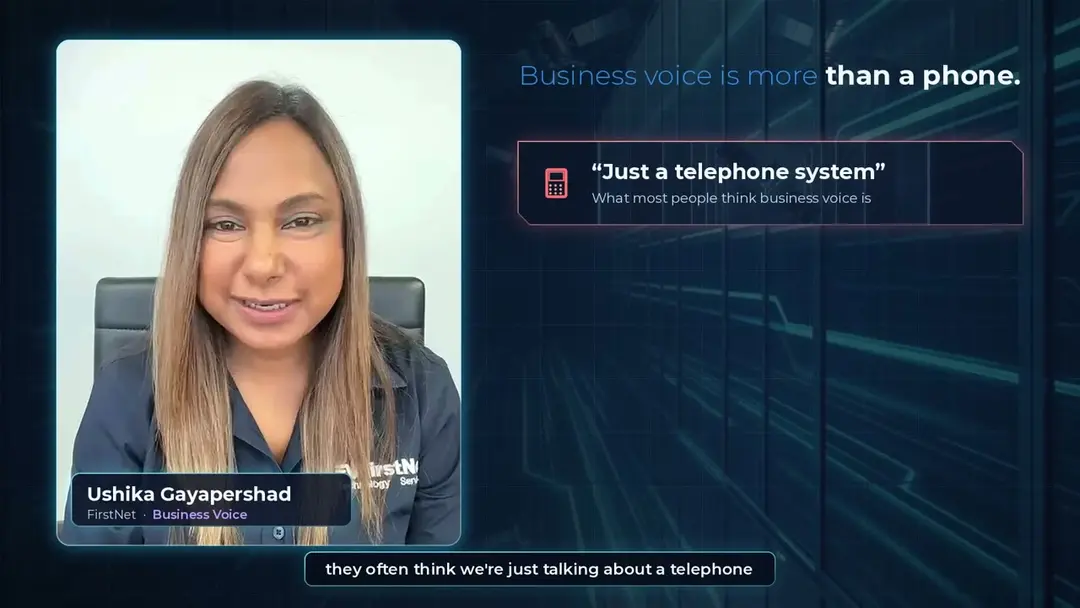
Business voice is more than a phone. Ushika Gayapershad introduces a new weekly series answering the questions businesses ask most, from desk phones and Teams calling to spam-flagged numbers and call recording.
Read the film as text
- When people hear "business voice", they often think we're just talking about a telephone system. But I get questions all the time like...
- Do we still need desk phones? Can we use Microsoft Teams as our business phone?
- Why does our number come up as spam when we call our customers?
- Do we really need to record our calls? And now, where does AI fit into all of this?
- The truth is, business voice has changed. It's not just about making and receiving calls anymore.
- It's about giving your people flexibility, making it easier for customers to reach you, understanding missed calls, protecting important conversations and using AI to remove some of the admin.
- My advice? Don't start with the technology. Start with one simple question. What frustrates you about your current phone system?
- That answer normally tells us where to start.
- Join me weekly for a series where I will answer some commonly asked questions around business voice solutions. I'm Ushika from FirstNet and our team looks forward to hearing from you.
Ushika Gayapershad, FirstNet
Watch the full video →Operator Connect or Direct Routing?
FirstNet sells both, and they can run side by side in the same Teams tenant. We start with the simplest option that fits your requirements.
Operator Connect
FirstNet is a Microsoft-curated operator listed in Teams Admin Center. Add FirstNet as your operator and manage numbers in Teams. No SBC to buy or configure; set up in days rather than weeks.
Direct Routing
FirstNet-owned, Microsoft-certified SBCs connect Teams to the phone network. Choose it to keep an existing carrier, run custom routing, keep an on-premises PBX or support analogue devices.
Native Teams calling, no hardware
Operator Connect does not currently support Common Area Phones, Meeting Rooms or ATA devices for analogue paging or fax. Where you need these, Direct Routing runs alongside in the same tenant.
- Calls from Teams desktop, mobile and web with no separate softphone
- Numbers assigned, ported and managed in Teams Admin Center
- Direct peering to Microsoft via Azure Peering Services for engineered QoS
- FirstNet manages PSTN connectivity and SBCs
- Coexists with Direct Routing and Microsoft Calling Plans
Flexibility for complex estates
- Carrier-agnostic: keep your existing voice carrier if you need to
- Location-based routing, custom dial plans and multi-tenant scenarios
- Coexists with on-premises PBXs, analogue lines and Common Area Phones
- TLS 1.2 signalling and SRTP media encryption
- Standard SBC, HA SBC pair or geographically diverse clusters
- No SBC capital outlay and no third-party SBC vendor
Five phases to Teams calling
Prepare
Tenant readiness review, licensing check and remediation checklist.
Plan
User and device design, dial plans and any Direct Routing coexistence.
Provision
Licences applied, FirstNet connected as operator or SBC, porting started.
Pilot
Auto attendants, call queues and dial plans built; pilot users cut over and tested.
Production
Full cutover, user and admin readiness, remaining sites, ongoing support.
Round out your Teams voice
- Compliance Recording via CallCabinet (powered by Smarsh)
- Truecaller verified caller ID for outbound-heavy teams
- Managed connectivity, because call quality depends on the underlay
- Teams Phone licences supplied by FirstNet as a Microsoft CSP
- Clarity for MS Teams call analytics and wallboards
Microsoft Teams Calling questions
Straight answers from the FirstNet team.
Read every answer in the Knowledge HubWhat licences do we need?
Each user needs Microsoft Teams Phone Standard or E5, and the tenant must be in Teams-Only mode. If you are not licensed yet, FirstNet can supply Teams Phone licences as a Microsoft CSP.
Can Operator Connect handle our lift lines, paging or fax?
Not currently. Operator Connect does not support ATA analogue devices, Common Area Phones or Meeting Rooms. FirstNet adds Direct Routing alongside Operator Connect in the same tenant for these.
We have a long-running carrier contract. Can we still use Teams calling?
Yes. Direct Routing is carrier-agnostic, so FirstNet's managed SBCs can sit on top of your existing SIP environment while your carrier relationship stays in place.
How long does number porting take?
A typical port takes 5 to 15 business days from the losing carrier. FirstNet captures the porting scope and signed Letter of Authority up front and stages cutover with a rollback plan.
What does the FirstNet SLA cover?
It covers FirstNet-managed components: PSTN connectivity, SBCs, number provisioning and support. Microsoft-side services remain Microsoft-dependent, and FirstNet handles the joint escalation for you.
Why not just buy Microsoft Calling Plans?
Calling Plans are Microsoft's own PSTN service. FirstNet adds local South African termination, local porting, local support and custom routing, and both can coexist in one tenant.
What is Microsoft Teams Operator Connect?
Operator Connect lets you add a phone operator to Microsoft Teams directly from the Teams Admin Center. FirstNet is a Microsoft-curated Operator Connect partner: you select FirstNet, and numbers, call routing and support flow through FirstNet. No SBC needs to be bought or hosted. FirstNet connects to Microsoft through Azure Peering Services (MAPS), a direct link engineered for call quality rather than best-effort internet.
What is Microsoft Teams Direct Routing?
Direct Routing connects your Teams tenant to the phone network through Session Border Controllers (SBCs). With FirstNet, the SBCs are FirstNet-owned and Microsoft-certified, so you need no SBC hardware or separate vendor. Direct Routing works with any carrier, supports custom routing such as location-based rules, and runs alongside an on-premises PBX, analogue lines, paging or common area phones. Signalling uses TLS 1.2 and media uses SRTP.
Does Operator Connect support common area phones and meeting room devices?
Not yet. According to Microsoft's published roadmap, Operator Connect does not currently support Common Area Phones, Meeting Rooms or analogue devices through ATAs. If you need these, FirstNet uses Direct Routing for those devices, which handles them through SBC-side routing. Operator Connect and Direct Routing can run side by side in the same Teams tenant, so most users can stay on Operator Connect.
What resilience options are there for Teams Direct Routing?
Resilience is matched to how critical each site is. A standard managed SBC suits single-site or non-critical calling. A high-availability SBC pair shares load across geographically diverse SBCs for critical and multi-site organisations. Full geographic redundancy spans two FirstNet SBC clusters. Calls are only as reliable as the internet link to Microsoft 365, so pairing with primary and backup connectivity is recommended.
What must be set up in Microsoft 365 before Teams calling goes live?
Your tenant needs to be in Teams-Only mode, users need Teams Phone Standard or E5 licensing, and someone with Global Admin access must be available for the integration window. FirstNet reviews tenant readiness, licensing, federation and existing voice routing first, then gives you a readiness checklist. If you are not yet licensed, FirstNet can supply the licences as a Microsoft CSP.
From the Knowledge Hub
In-depth answers about Microsoft Teams Calling

Where voice fits
- Sovereign AI AI that stays home, in every layer.
- Voice Every call, clear.
- Security Threats, contained.
- Cloud Data, protected.
- Connectivity Always connected.
Enriched by Sovereign AI: turn call recordings into structured, searchable data on the AI Factory; the recordings never leave South Africa. Explore the AI Factory